
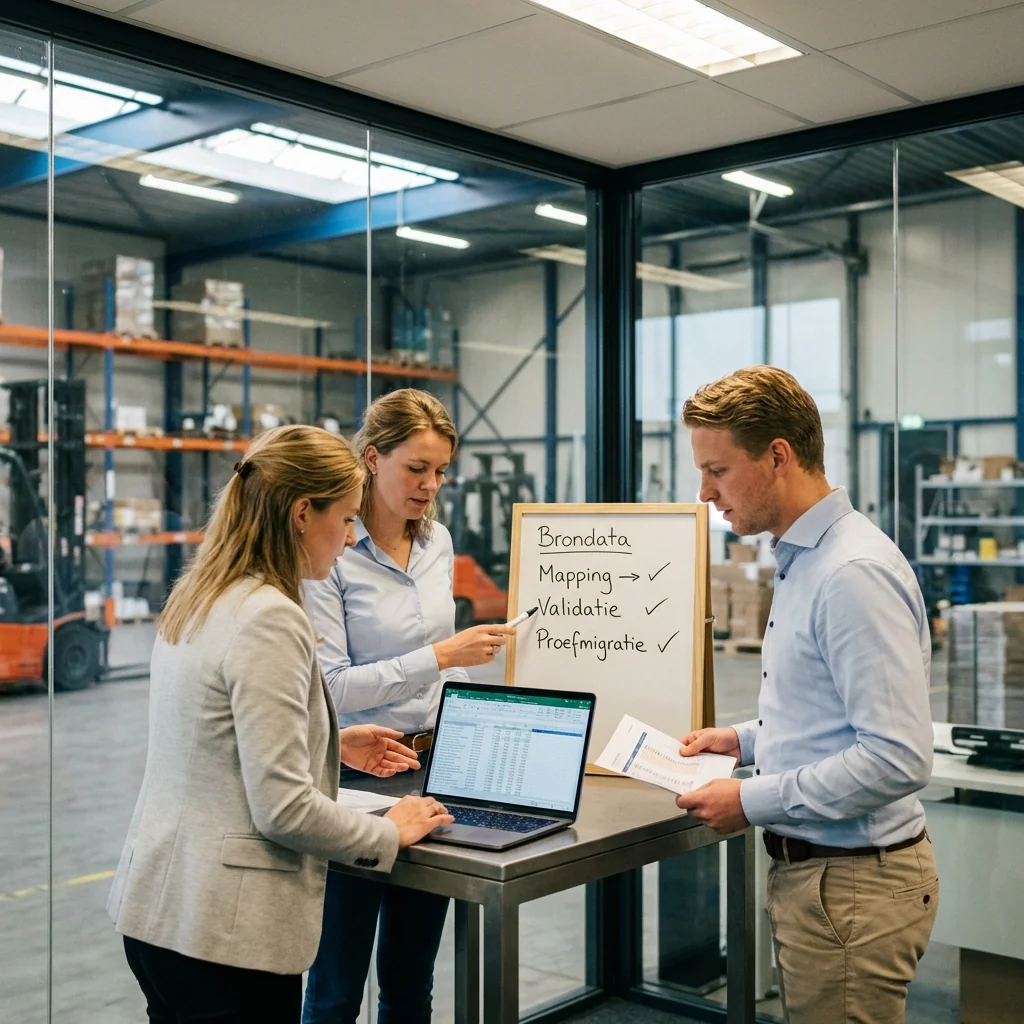
Preparing and guiding your ERP data migration
An ERP data migration calls for agreements on which data moves, who checks it and when it is ready for use. ERP Company supports you with data quality, trial migrations and the transition to your new system, so you can check in advance where adjustments are needed.
Data quality and governance
Trial migrations and validation
Secure data architecture
Why data migration often goes wrong
Data migration carries risk. Without a structured approach, an ERP migration can lead to data loss, quality issues or a delayed go-live.
How we approach data migration
ERP Company uses a structured, iterative approach to data migration. That way you see before go-live where the data is not yet right and what is needed to maintain data quality.
Structured approach per data domain with scope, mapping and cleansing steps
What does this deliver?
From our practice
In our experience...
Data migration is not only a technical task but also an organisational one: who owns which data, and who validates it? Agree on this early in the project, so these questions do not come up only at the end.
Data migration during an ERP transition is the controlled transfer of business data from the old to the new system. This part needs attention early, as data quality issues often only become visible during migration.
Data management covers the structural assurance of data quality, ownership and governance. This is essential because the reliability of reports, processes and decision-making depends entirely on correct master data.
Frequently asked questions about data migration
We start with a thorough data audit per domain and define clear mapping rules. All transformations are validated and tested across multiple trial migrations. Exit criteria for completeness, reconciliation and performance ensure we only migrate when everything checks out. Backup and rollback procedures are agreed in advance.
Master data governance covers the processes, roles and rules for managing critical master data such as customers, suppliers and products. We set up workflows for data creation, modification and archiving. This helps you maintain data quality after go-live and keep data consistent across systems.
We start with a data quality assessment to identify problems. Then we design cleansing rules and transformations to make the data fit for the new system. Where data cannot be salvaged, we document this explicitly and agree on how to handle it in the new environment.
We can migrate both current and historical data, depending on your needs and compliance requirements. For historical data we often design a separate archive structure to optimise performance. We advise on the right balance between availability and system performance.
Get more information or schedule a conversation
Have a question about your data, migration or data quality? Our specialists are happy to help you find the right approach. Submit your question and we will schedule a meeting.
Related topics
Data Management & Migration Request
Fill in the form below. We will contact you to discuss your data question.
Direct contact
Phone
085 060 7626Location
Dorpstraat 71
5595 CD Leende
Netherlands
Contact
We will get back to you about your request. For urgent matters, you can call us directly.